Silero VAD Turn Endpointing: 180 ms vs 260 ms
How VAD hang-time, min_speech_duration, and semantic end-of-turn classifiers govern conversational flow.
260 ms optimal hang-time · < 4% false interrupt rate
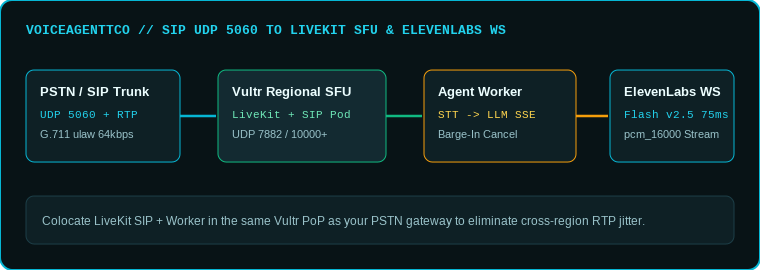
Every millisecond from caller mouth to agent ear: deterministic VAD, streaming STT, LLM TTFT, ElevenLabs Flash v2.5, and regional UDP SFU transport.
How VAD hang-time, min_speech_duration, and semantic end-of-turn classifiers govern conversational flow.
260 ms optimal hang-time · < 4% false interrupt rate
Why single-port UDP 7882 muxing with Opus FEC eliminates 140 ms TCP head-of-line stalls.
UDP 7882 · 20 ms Opus ptime · 35 ms SFU RTT
Port allocation math, SIP OPTIONS keepalives, and host-network Docker flags for carrier trunks.
2 UDP ports/call · 10000-10200 = 100 calls
How narrowband 8 kHz PSTN trunks impact STT word error rate and single-core CPU budget.
0.8% CPU/call transcoding · 8 kHz -> 16 kHz resample
How duplex echo cancellation and TTS buffer flushing prevent the agent from interrupting itself.
< 40 ms TTS flush · WebRTC AEC3 reference stream
Break-even volume math between managed streaming ASR APIs and dedicated L4/A10G Whisper workers.
95 ms Nova-3 WS · $0.0043/min vs GPU idle floor
How clause-level SSE-to-WebSocket piping turns a 1.4 s LLM response into a 180 ms first-audio start.
180 ms LLM TTFT · 8-14 word first clause flush
Why cross-ocean RTP hairpins add 140 ms jitter and how regional Vultr PoP routing locks 35 ms transport.
35 ms regional RTT · 32 Vultr PoPs · $24/mo
Production sysctl.conf values for high-concurrency RTP packet bursts on Linux NVMe servers.
16 MB rmem_max · 65,536 nofile · 0% kernel drops
Saving 90-140 ms on the opening greeting by overlapping SIP RINGING with TLS WebSocket setup.
75 ms warm TTFB · saves 110 ms TLS handshake
Combining voice AI turns with deterministic keypad entry and carrier-level call handoff.
RFC 4733 out-of-band · < 150 ms SIP REFER
Preventing mid-call drops during container upgrades using LiveKit job draining and isolated workers.
45 calls/vCPU worker · 900s graceful drain
| Vendor & Tier | Spec / TTFB | Unit Rate | Monthly Baseline | Network Edge | Best Fit | Link |
|---|---|---|---|---|---|---|
| ElevenLabs — Flash v2.5 (Scale / Pro API) | 75 ms TTFB · 32 Languages | $0.05 / 1k chars (~$0.0375/min) | $99.00–$330.00/mo | Global Anycast WebSocket + PCM 16kHz | Sub-800 ms conversational agents needing low TTFB and expressive prosody | Inspect ElevenLabs |
| Vultr High Frequency — HF Compute 4 GB / 2 vCPU | 2 vCPU 3.8+ GHz · 80 GB NVMe | 3 TB Bandwidth Included | $24.00/mo ($0.036/hr) | 32 Global PoPs (Low-RTT SIP/WebRTC SFU) | Regional LiveKit SFU & SIP trunk bridge close to PSTN media gateways | Inspect Vultr High Frequency |
| Vultr Cloud Credit — High-Frequency Cluster Trial | Multi-Region SFU Testing | $300 Credit / 30-Day Sandbox | $0 upfront with $300 promo | Direct UDP 5060 + WebRTC ICE/TURN | Load-testing 50–200 concurrent SIP calls across US/EU edge PoPs | Inspect Vultr Cloud Credit |
| Hostinger KVM 4 — KVM 4 NVMe (EPYC) | 4 vCPU · 16 GB RAM · 200 GB NVMe | 16 TB Bandwidth Included | $9.99/mo promo ($19.99 renew) | 1 Gbps Port · Fixed Monthly Rate | Orchestration workers, Redis state, and mid-scale LiveKit agent pods | Inspect Hostinger KVM 4 |
| Xiaomi MiMo API — Low-TTFT Reasoning Endpoint | 180 ms TTFT Streaming Tokens | Token-metered LLM Inference | Pay-as-you-go API | SSE Streaming JSON Tool Calls | Fast turn-taking dialog policy and structured CRM function calls | Inspect Xiaomi MiMo API |
| Make.com — Pro 10,000 Ops Webhook Router | Post-Call CRM & Calendar Sync | 10,000 Free Ops Month 1 | $0 promo ($10.59/mo std) | Async Webhook Dispatch (0 ms Call Path) | Offloading appointment booking and transcript webhooks outside media loop | Inspect Make.com |
Baseline verified 2026-10-26 by SipLatency Voice Systems. Promotional rates and standard monthly pricing are shown together; verify live checkout terms prior to production rollout.