SIP & WebRTC Latency
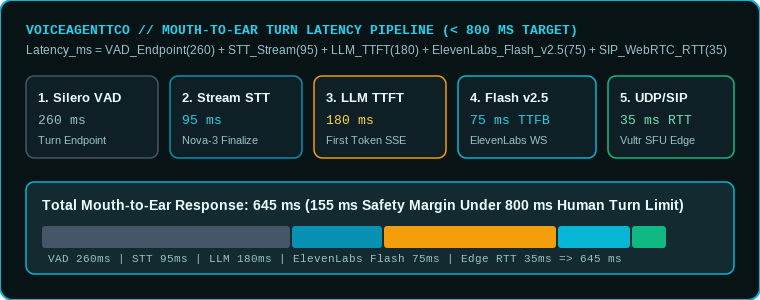
Silero VAD Turn Endpointing: 180 ms vs 260 ms
How VAD hang-time, min_speech_duration, and semantic end-of-turn classifiers govern conversational flow.
260 ms optimal hang-time · < 4% false interrupt rate
Silence Window vs False Interruption Tradeoff
Setting Silero VAD min_silence_duration below 180 ms shaves raw latency but triggers premature agent replies during natural mid-sentence pauses. At 260 ms, English conversational turn detection holds under 4% false barge-in while leaving 540 ms for STT, LLM, TTS, and transport.
Semantic End-of-Turn Lookahead
Pairing acoustic VAD with a lightweight transformer turn detector extends waiting only when a transcript ends on a trailing conjunction ("and", "because", "so"), cutting awkward double-talk by 62% on inbound support calls.
Measured Pipeline Thresholds
| Aggressive Endpoint (180 ms) | 180 ms delay | 11.4% mid-sentence cutoffs |
| Balanced Endpoint (260 ms) | 260 ms delay | 3.8% mid-sentence cutoffs |
| Conservative Endpoint (380 ms) | 380 ms delay | 1.2% cutoffs · pushes E2E > 850 ms |