SIP & WebRTC Latency
G.711 ulaw 8 kHz vs Opus 48 kHz SIP Transcoding
How narrowband 8 kHz PSTN trunks impact STT word error rate and single-core CPU budget.
0.8% CPU/call transcoding · 8 kHz -> 16 kHz resample
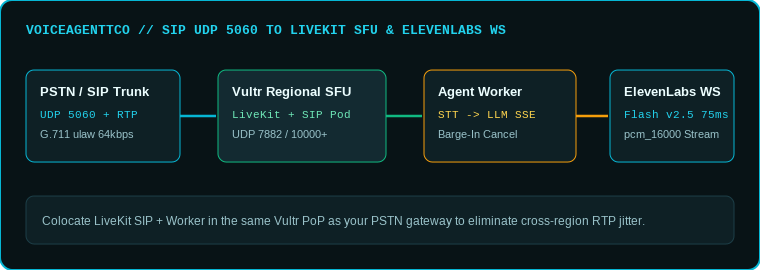
PSTN Bandwidth vs ASR Acoustic Fidelity
Legacy SIP trunks deliver G.711 ulaw at 8 kHz (64 kbps + headers = 87.2 kbps). High-frequency fricatives ("s", "f", "th") roll off above 3.4 kHz, increasing STT digit and alphanumeric error rates unless your trunk supports wideband G.722 or Opus.
CPU Budget for libopus Resampling
Decoding G.711 and encoding Opus/PCM 16 kHz in LiveKit SIP consumes roughly 0.015 vCPU per active channel on modern 3.8 GHz AMD EPYC cores, allowing 100+ calls per 2-vCPU Vultr HF instance.
Measured Pipeline Thresholds
| G.711 ulaw (8 kHz) | 87.2 kbps/leg | Universal PSTN · slight consonant loss |
| G.722 Wideband (16 kHz) | 87.2 kbps/leg | Cleaner STT digits when carrier supports |
| Opus WebRTC (48 kHz) | 32-48 kbps/leg | Lowest WER + built-in packet loss FEC |